


The primary reason architects specify fixed flat rooflights for high-end projects is their superior airtightness. Unlike opening models that require mechanical seals, a fixed unit is a solid, hermetically sealed barrier against the elements.
By utilizing three panes of toughened safety glass and two cavities filled with insulating Argon gas, our fixed units eliminate the “cold bridge” often found in cheaper alternatives. This means no condensation, no drafts, potentially a significant reduction in your annual heating bills.
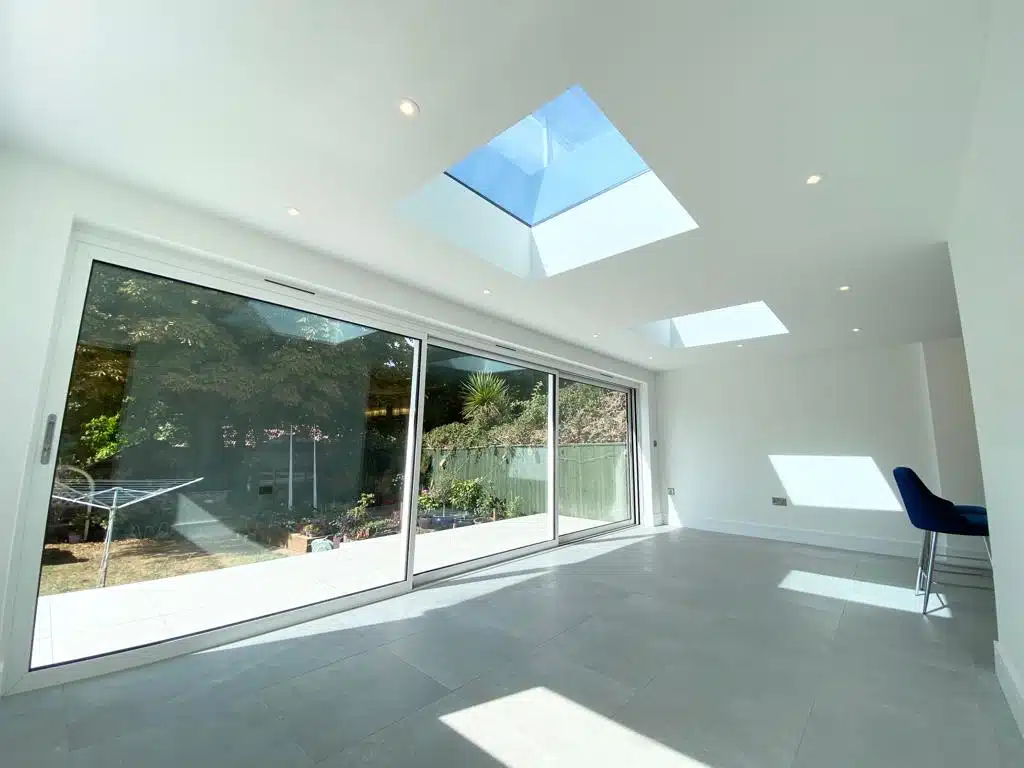
When planning a home extension in the UK, creating a light-filled, open-plan living space is usually top of the priority list. Large expanses of structural glass, bi-fold doors, and flat rooflights have become design staples for modern kitchen diners and garden rooms.
However, incorporating extensive glazing introduces a major engineering challenge: thermal efficiency.
With rising UK energy costs and increasingly strict building standards, modern homeowners can no longer afford to compromise on insulation. Here is why triple-glazed rooflights represent the future of energy-efficient UK extensions—and how choosing the right glazing specification protects both your comfort and your property value.
1. Compliance with UK Building Regulations (Part L)
Under the updated UK Building Regulations (Part L), standards for conservation of fuel and power have tightened significantly. These updates set strict limits on maximum allowable U-values—the standard metric used to measure heat loss through building materials (where a lower number indicates better thermal insulation).
To meet these targets, extension plans must prove that overall heat retention isn’t compromised by large glass installations:
- Standard Double Glazing: Typically delivers U-values between 1.2 W/m²K and 1.4 W/m²K. While compliant in basic scenarios, it leaves little room for error if your extension design features large glazed areas relative to floor space.
- Triple Glazed Rooflights: Achieve exceptional U-values as low as 0.6 W/m²K to 0.8 W/m²K across the center pane.
By installing triple-glazed skylights, architects and homeowners can easily meet—and exceed—Part L requirements without sacrificing the size or layout of their rooflights.
2. Eliminating Cold Spots and Internal Drafts
One of the most common complaints with older or poorly specified glazed extensions is the “radiant cold” phenomenon during UK winters. Even in a heated room, sitting under a large double-glazed rooflight can feel chilly due to convection currents pulling warm air toward the cooler glass surface.
How Triple Glazing Solves This:
- Three Panes of Toughened Glass: Creates two insulating internal cavities rather than one.
- Argon Gas Infill: Low-conductivity Argon gas trapped inside the cavities drastically reduces heat transfer via conduction.
- Warm-Edge Spacer Bars & Low-E Coatings: Reflected internal heat stays inside the home while thermal bridging around the frame edges is eliminated.
The result is an internal glass surface temperature that remains close to room temperature, creating a comfortable living space directly beneath the skylight year-round.
3. Acoustic Insulation for Urban & Suburban Living
Thermal efficiency isn’t the only advantage of adding a third glass pane. Sound insulation improves markedly with increased mass and variable glass thicknesses.
Whether you live near a busy main road, under a flight path, or in an area prone to heavy rainfall, triple glazing significantly reduces ambient sound transmission. Rain impact noise—a frequent issue with large flat rooflights—is muffled to a subtle background whisper, maintaining a quiet indoor environment.
4. Year-Round Comfort: Balancing Heat Retention with Solar Control
A common misconception is that triple glazing turns an extension into a greenhouse during summer. In reality, high-performance architectural glass is engineered with solar control coatings that work in both directions:
In Summer: Blocks excessive solar heat gain (measured via the G-value), preventing the greenhouse effect on hot days.
In Winter: Traps heat inside, reducing reliance on central heating and lowering energy bills.
Why Choose Our Triple-Glazed 0.6 Specification?
| Feature | The Custom Rooflights Benefit |
| Energy Efficiency | 0.6 W/m²K U-value (40% more efficient than double glazing). |
| Glass Quality | 46mm total unit thickness with dual Low-E coatings. |
| Maintenance | Self-cleaning glass as standard on all triple-glazed units. |
| Durability | Marine-grade powder coating and a 20-year unit seal warranty. |
| Delivery | Available in 30 stock sizes for delivery in as little as 48 hours. |
Future-Proof Your Home Today
Investing in triple glazing is a strategic move. As UK homes move toward “Net Zero” standards, properties with high-efficiency fixed flat rooflights will hold their value better than those with outdated, inefficient glazing.
Browse our range of Triple Glazed Flat Rooflights to find the perfect fit for your project or use our online calculator to get an instant price for a bespoke size.





